
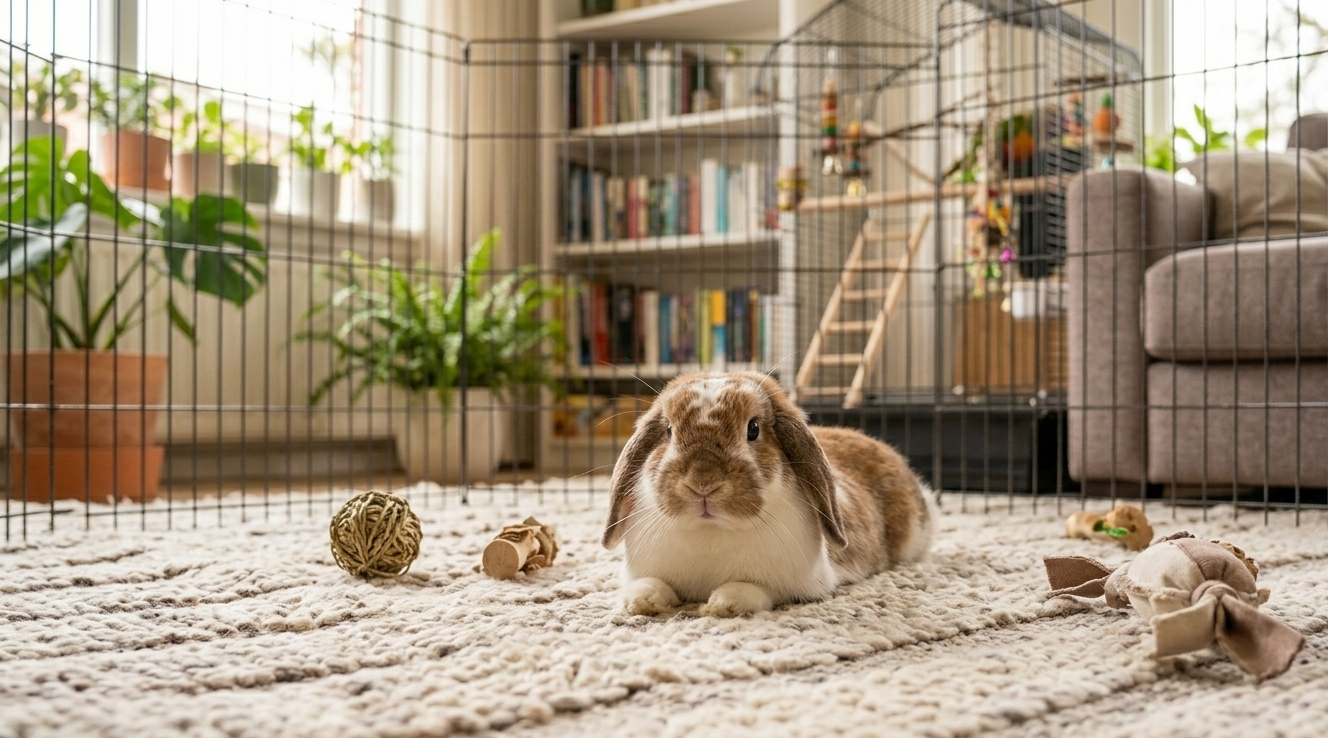
Your rabbit poops everywhere. On the carpet. On the couch. Little pellets scattered across your floor like confetti. You love your bunny, but you’re tired of following them around with a dustpan.
Maybe you’ve tried putting a litter box in their space, but they ignore it. Maybe you’ve heard that rabbits can be litter trained, but you’re skeptical. Maybe you just want your house rabbit to stop treating your entire living room like a bathroom.
Here’s the good news: rabbits can absolutely be litter trained. In fact, they’re naturally inclined to use a designated bathroom area. With patience and the right approach, most rabbits will reliably use a litter box—making life with a house rabbit so much easier.
This guide will walk you through how to litter train your rabbit step-by-step, troubleshoot common problems, and help you create a setup that actually works.
Why Litter Training Your Rabbit Matters
Let’s be honest: litter training isn’t just about convenience (though that’s a big part). It’s about giving your rabbit more freedom.
A litter-trained rabbit can roam freely in your home without you worrying about constant accidents. They can have a larger living space. You can let them hop around while you work, watch TV, or relax—without the stress of cleaning up every five minutes.
Plus, rabbits are cleaner than people think. They naturally prefer to eliminate in one spot. Wild rabbits designate specific areas as latrines. Your domestic rabbit has the same instinct—you just need to work with it.
Can All Rabbits Be Litter Trained?
Most rabbits can learn to use a litter box, but some are easier than others.
Factors that affect litter training:
Spayed or neutered rabbits train easier. Intact rabbits are more likely to mark territory with urine and droppings. Once they’re fixed, the hormonal drive to mark decreases significantly, and litter training becomes much simpler.
Age matters. Adult rabbits tend to train faster than babies. Young rabbits (under 6 months) are still developing bladder control and territorial instincts.
Personality plays a role. Some rabbits are naturally fastidious and take to litter boxes immediately. Others are more stubborn.
Health issues can interfere. If your rabbit has a urinary tract infection, kidney problems, or arthritis, they may struggle with litter box use.
If your rabbit isn’t spayed or neutered yet, seriously consider it. It’s the single biggest factor in successful litter training.
What You’ll Need for Rabbit Litter Box Training
Before you start, gather the right supplies.
Litter box: Use a box with low sides for easy entry. Cat litter boxes work well for larger rabbits. Corner litter boxes fit nicely in cages or small spaces. Some rabbits prefer boxes with higher backs to prevent spray.
Rabbit-safe litter: NEVER use clay, clumping, or scented cat litter. Rabbits nibble litter, and toxic ingredients can make them sick. Safe options include:
- Paper-based litter (like recycled paper pellets)
- Aspen shavings
- Compressed wood pellets (kiln-dried)
- Hay placed over litter
Hay: Rabbits love to munch while they poop. Place a hay rack near or over the litter box, or put hay directly in one corner of the box.
Enzyme cleaner: For accidents. You need a cleaner that breaks down urine odor completely, or your rabbit will keep going back to that spot.
Patience: This isn’t instant. Some rabbits train in days. Others take weeks.
Step-by-Step: How to Litter Train Your Rabbit
Let’s break this down into manageable steps.
Step 1: Start with a Confined Space
Don’t give your rabbit free run of the house on day one. Start small.
Set up your rabbit in a pen, large cage, or single room. Place one or two litter boxes in the corners where they naturally tend to go. (Rabbits usually pick corners.)
Watch where your rabbit urinates and poops. If they consistently choose a specific spot, move the litter box there. You’re working with their instincts, not against them.
Step 2: Make the Litter Box Appealing
Your rabbit should want to spend time in the litter box.
Here’s how:
Put hay in or near the box. Rabbits eat and poop at the same time. If there’s fresh hay in the litter box, they’ll hang out there and naturally eliminate.
Use a hay rack attached to the side. Position it so your rabbit has to sit in the litter box to reach the hay.
Keep the box clean. Rabbits won’t use a filthy litter box any more than you’d use a disgusting bathroom. Scoop daily, change litter 2-3 times per week.
Step 3: Encourage Use and Reinforce Success
When you see your rabbit using the litter box, calmly praise them. A gentle “good bunny” and maybe a small treat works. Don’t go overboard—rabbits startle easily—but positive reinforcement helps.
If your rabbit starts to pee or poop outside the box, gently pick them up (if they tolerate it) and place them in the litter box. Don’t scold. Just redirect.
Step 4: Clean Up Accidents Properly
Accidents will happen. How you clean them matters.
Use an enzyme cleaner to remove all traces of urine smell. If your rabbit can still smell their pee, they’ll think that spot is an acceptable bathroom.
Pick up stray poops and place them in the litter box. This reinforces where poop belongs.
Don’t punish your rabbit for accidents. They don’t understand punishment, and it will only make them afraid of you.
Step 5: Gradually Expand Their Space
Once your rabbit is consistently using the litter box in their confined area (usually 1-2 weeks), start expanding their space.
Add one room at a time. Place additional litter boxes in each new area—especially in corners.
Watch their behavior. If accidents increase, you’ve expanded too fast. Scale back and give them more time.
Step 6: Reduce Extra Litter Boxes Over Time
Once your rabbit is reliably trained in a larger space, you can experiment with removing extra boxes.
Most rabbits will return to their main litter box even if they have to hop across the room. But some rabbits prefer multiple boxes, especially in large spaces. That’s fine. Use however many boxes work.
Common Rabbit Litter Box Problems (and How to Fix Them)
Litter training doesn’t always go smoothly. Here are the most common issues and solutions.
Problem: My Rabbit Pees in the Litter Box But Poops Everywhere
This is super common, especially with unfixed rabbits.
Why it happens: Rabbits drop pellets while hopping around. It’s territorial marking.
Solution:
- Spay or neuter your rabbit
- Accept that a few stray poops are normal (they’re dry and easy to sweep)
- Provide multiple litter boxes
- Be patient—it often improves over time
Problem: My Rabbit Used to Be Litter Trained But Now Isn’t
Sudden changes in litter box behavior usually mean something’s wrong.
Possible causes:
- Medical issue (UTI, bladder stones, arthritis)
- Stress (new pet, new person, change in environment)
- Dirty litter box
- Hitting sexual maturity (if not fixed)
- New rabbit in the home triggering territorial marking
Solution: Visit your vet first to rule out health problems. Then address environmental stressors.
Problem: My Rabbit Won’t Get in the Litter Box
The box might be the issue.
Fixes:
- Make sure sides are low enough for easy entry
- Try a bigger box
- Try a different type of litter (some rabbits have texture preferences)
- Add more hay to make it appealing
Problem: My Rabbit Sits in the Litter Box But Pees Over the Edge
Some rabbits back up too far or spray.
Solution:
- Use a box with higher sides or a cover
- Try a corner box that fits snugly against walls
- This is more common in unneutered males—neutering usually fixes it
Tips for Success with Rabbit Litter Box Training
Be patient. Some rabbits train in a week. Others take a month or more.
Clean boxes regularly. Rabbits are picky. A gross litter box = accidents elsewhere.
Spay or neuter. Seriously, this solves 90% of litter training struggles.
Use multiple boxes initially. It’s easier to remove extras later than to deal with constant accidents.
Don’t punish. Rabbits don’t understand punishment. It only damages your bond.
Watch for patterns. If your rabbit always pees in one specific spot, put a litter box there.
Expect some stray poops. Even well-trained rabbits drop a few pellets here and there. It’s normal.
When to Seek Help
If your rabbit isn’t making any progress after 4-6 weeks of consistent effort, or if they suddenly stop using the litter box after being trained, see your vet.
Medical issues like urinary tract infections, bladder sludge, kidney problems, or arthritis can make litter box use painful or impossible.
A vet can also confirm whether your rabbit is truly spayed or neutered if you adopted them and aren’t sure.
You’re Not Doing It Wrong
If litter training feels frustrating, that’s normal.
Rabbits aren’t dogs. They don’t train the same way. They’re independent, sometimes stubborn, and they have their own ideas about how things should work.
But here’s what matters: you’re trying. You’re putting in the effort to give your rabbit more freedom and a better quality of life.
Even small progress counts. If your rabbit uses the litter box 80% of the time, that’s a win. If they’re using it in their pen but not the living room yet, that’s still progress.
Litter training takes time. Be patient with your rabbit—and with yourself.
Moving Forward: Life with a Litter-Trained Rabbit
Once your rabbit is reliably litter trained, everything gets easier.
You can let them roam freely. You can spend time together without constantly cleaning. You can enjoy having a house rabbit without feeling like you’re living in a barnyard.
Start small. Be consistent. Give your rabbit time to figure it out. Most rabbits will get there.
And remember: even “perfect” litter-trained rabbits drop a few poops here and there. That’s just life with bunnies.
You’ve got this. Your rabbit’s got this. And soon, you’ll both have a much cleaner, happier living situation.
Leave a Reply